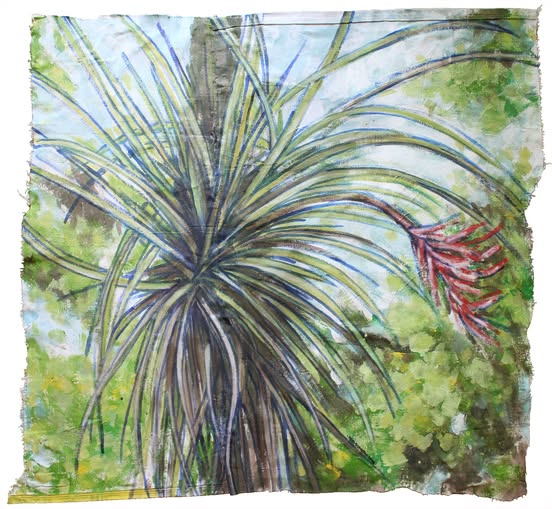
From August 19 to September 16, La Oficina de Babel, a love project by Cristina Vélez Roque and Anamarie Sierra Pagán, appears in office #01 of building 1095 on Wilson Avenue, San Juan, Puerto Rico. In this office, a series of research on semiotics, psychoanalysis and electronics is shared to answer certain questions. Is the unconscious, in fact, structured like a language? Does a tree that falls in the middle of the forest and no one hears it make a noise? How can poetry optimize its response time?
Disordering a system repeatedly is not chaos, it is generating another system. Disorder or chance with a system is a system and not chaos. It becomes a system by the hand of humans. Chaos is something that this species does not articulate, does not know and cannot grasp. We just have to ask: how to “chaosify” language?

The Office of Babel is a site-specific installation on semiotics, psychoanalysis and electronics to answer this question that Gabriel Orozco put on the table a few years ago. It collects a series of investigations shared between Cristina Vélez Roque and Anamarie Sierra Pagán to imagine a logic of multiplicity. This imagination has been realized under the creative guidelines of Kenneth Goldsmith and some possibilities of interfaces in Raspberry Pi on homemade supports. In this sense, the Office attacks contemporary work dynamics by improvising a slow and dark office against reasoned production. The Office is exploring ways so that the machine can assist with affection. The question arises: how can poetry optimize its response time?


The Spanish language is made up of 27 letters with which it is possible to make 2,136 syllables. The minimum unit of meaning in language is the morpheme. In- has a meaning of negation, as in inestable –mente is a suffix that converts adjectives into adverbs, such as frequently; and -greg- appears in a vast set of words etymologically linked by the concept of cattle, such as add, segregate, disintegrate. But language is not just composed of morphemes and lexemes. The subtle weave of meanings is studied by semantics, while syntax deals with the ways in which words can be combined to give rise to meaningful sentences and statements. However, some statements do not occur because we do not have the occasion to use them. Others are prohibited or make no sense. The grammatical person looks for a grammar for admissible statements and never incongruent statements for spontaneous grammars. As a consequence, outside of Spanish or any socialized language code, systems have been devised for less restricted uses. For example, this project works from context-free grammar. The notation most frequently used to express free grammar is the Backus-Naur form. Free grammars allow us to describe most programming languages and are simple enough to allow the design of efficient syntactic analysis algorithms. Despite having a finite base grammar, it is possible to surprise with unusual guides and recombinations of what is given. There are limits that are natural (like death and gravity), but grammatical laws are accidental. They are forecasts and provisions towards a biased profit that we can cancel, recompose and multiply.


It also makes sense to describe this office as a rhizome. In March ’77, Gilles Deleuze and Félix Guattari shared the closest thing to a non-unitary model of thought that they could formulate. Along the way, they gave it the botanical term for an underground stem with several horizontally growing buds. This thought-rhizome did not need great historical foundations to strengthen itself, but rather many extensive intuitions that the Office has also consumed to articulate itself. The rhizome is foolish and unproductive. The rhizome is an abstract machine and a concrete tool towards liberation. If we want to modify the arts, sciences or social struggles in a liberating sense, the rhizome tells us to operate micropolitically. It operates in micro from spontaneous formations, not determined and not codified by power. For example, there is no real code in a ritual, a campfire, or an automatic prayer trigger. Neither in the rhizome nor in the Office is there any presentation of meaning. There is only one-way circulation. Never a greeting. Not a stop. Just deployment and acceleration.


For visits or more information, write to +1 787 603 7341 or at anamariesierrapagan@gmail.com.
About the Artists

Anamarie Sierra Pagán
Lives and works in Cabo Rojo, Puerto Rico. In 2018 she completed a bachelor’s degree in Image and Movement from the School of Fine Arts and Design of Puerto Rico and held open training at the Institute of Philosophical Research at UNAM, Mexico City. In 2020 she went through La Practica de Beta Local and the residence of FlussLab, a STEAM approach laboratory with a shared base between Buenos Aires (AR) and Berlin (DE). She is currently studying a master’s degree in Epistemology of Social and Natural Sciences at the Complutense University of Madrid. From her practice she writes, designs, films, draws, manufactures and ventures into programming. The philosophy of mind is informed by considering the emotional structures of art, its semantic limits and human capacities for abstraction.
Cristina Vélez Roque
Lives and works in Cabo Rojo, Puerto Rico. She completed university studies from 2012 to 2017 at the School of Fine Arts and Design of Puerto Rico, obtaining a BFA in Design and Digital Art. She was part of the Tiguere Corp. design studio from 2016 to 2019 and has collaborated with the Tembol design studio since then. She has participated in exhibitions in various spaces in Puerto Rico such as Casa Jefferson, the Old Arsenal of the Spanish Navy and Gallery 209. She is currently pursuing doctoral studies in Clinical Psychology at Ponce Health Sciences University. In her work she probes messages to rebuild affections. Play with programming systems, language systems and the catalog of their symbols towards a practice free of knowledge and conclusions
Text and images provided by Anamarie Sierra Pagán y Cristina Vélez Roque.
Photography Credits: Kelvin Joel Rodríguez